
Antenatal care
The percentage of pregnant women who made contact with antenatal care (a first visit, four or more visits, a first visit in the first trimester) and who received its main interventions.
Antenatal careAntenatal care (ANC) Care during pregnancy at a health facility. ANC1 is the first visit; ANC4 the fourth. is the care a woman receives from health services during pregnancy. Its coverage is the percentage of pregnant women in the population who made contact with antenatal care (a first visitANC1 The first antenatal care visit of a pregnancy, usually at about 20 weeks (4-5 months) of pregnancy., four or more visitsANC4 Four or more antenatal care visits during a pregnancy. Its survey coverage is the percentage of women aged 15–49 with a live birth who had four or more visits during their last pregnancy., a first visit in the first trimesterFirst-trimester ANC A first antenatal care visit made in the first three months of pregnancy; its coverage shows how early women enter pregnancy care.) or who received one of its interventions, such as malaria prevention or iron-folic acid tablets.
At a glance
- Measures: ANC1, ANC4 and first-trimester ANC coverage, and the coverage of the contents of antenatal care.
- Good result: ANC4 coverage moving toward the global target of 90%, with no implausible values over 100%.
- In the app: National Coverage, tab ANC 4 Visits (other ANC indicators under Custom).
Why
Most countries have at least one antenatal care indicator with a target in the national plan. The global ENAP/EPMMENAP and EPMM The Every Newborn Action Plan (ENAP) and the strategies for Ending Preventable Maternal Mortality (EPMM), the global plans for newborn and maternal health. Their coverage targets include 80% of districts with institutional delivery coverage of at least 80%. coverage targets for 2025 are: globally, at least 90% of pregnant women with 4 or more antenatal care visits, and 90% of countries with at least 70% coverage.
ANC1 is often considered an indicator of basic access to health services. It is high in most countries, and in many instances the numbers of ANC1 visits in the routine health facility data can provide a better denominator for the antenatal care and delivery indicators than population projections (see Denominator assessment and selection).
What
There are several antenatal care indicators that capture:
- Contact with health services during pregnancy: ANC first visit, ANC 4 or more visits, ANC first visit in the first trimester.
- Contents of the services provided: intermittent preventive therapyIntermittent preventive treatment (IPT) Doses of an antimalarial drug given to pregnant women during antenatal care where there is malaria risk; IPT2 and IPT3 are two and three doses. (IPT2 or IPT3) against malaria, HIV testing, syphilis testing and iron-folic acid (IFA) supplementationIron-folic acid (IFA) supplementation Iron and folic acid tablets given to pregnant women during antenatal care; coverage counts women who received at least 90 tablets. (at least 90 tablets given to the pregnant woman). Some countries will not have policies for all of these diagnostic or therapeutic interventions during pregnancy (e.g., no IPT if there is no malaria risk).
| Indicator | Numerator | Denominator (facility data) | Survey denominator | Interpretation |
|---|---|---|---|---|
| ANC1 coverage | Women with a first antenatal visit | Estimated total pregnant women in the population | Women aged 15-49 years with a live birth in the last 2 years | Basic access to health services; high in most countries |
| ANC4 coverage | Women with 4 or more antenatal visits | Estimated total pregnant women | Women aged 15-49 years with a live birth in the last 2 years | Continuity of antenatal care; compare with the 90% global target |
| First-trimester ANC coverage | Women with a first visit in the first trimester | Estimated total pregnant women | Women aged 15-49 years with a live birth in the last 2 years | Early entry into pregnancy care |
| IPT2, IPT3 coverage | Women receiving 2 or 3 doses of IPT | Estimated total pregnant women | Women aged 15-49 years with a live birth in the last 2 years | Malaria prevention in pregnancy, where there is malaria risk |
| IFA, HIV and syphilis testing coverage | Women receiving the intervention | Estimated total pregnant women | Women aged 15-49 years with a live birth in the last 2 years | Content of antenatal care |
Formula
where
- is the coverage of the indicator in the year, in percent;
- is the adjusted numberAdjusted numerator (Nadj) N_adj = N_rep + N_rep x (1/C - 1) x k, where N_rep is the raw reported number and C the reporting completeness (proportion of expected reports received). of women who received the service in the year (for example ANC4 visits), from Data adjustment;
- is the estimated number of pregnant women in the year, from the denominator chosen in Denominator assessment and selection.
With the ANC1-derived denominator, the number of pregnant women comes from the facility ANC1 numbers and the survey ANC1 coverage:
where is the number of ANC1 visits reported in the year and the ANC1 coverage in the most recent survey (as a proportion).
Worked example: survey ANC1 coverage is 95% and there were 100,000 ANC1 visits in the year, so there were 100,000 ÷ 0.95 = 105,263 pregnant women. If 52,000 women made 4 or more visits, ANC4 coverage is 52,000 ÷ 105,263 × 100 = 49.4%. ANC1 coverage with this denominator is 95%, the survey value, by construction.
Settings
| Setting | Default | What it means |
|---|---|---|
| Maternal denominator | The one chosen in Denominator Selection | The estimate of pregnant women (and of deliveries and live births) used for the antenatal care and delivery indicators. The chart caption names it. |
| ANC4 coverage target | 70% | An area reaches the ANC4 target when its coverage is at least this, on the Coverage Target page. |
Interpretation
- Is ANC1 high, and ANC4 much lower? A large gap between the first and the fourth visit points to weak continuity of antenatal care; see the Continuum of care.
- Is ANC4 moving toward the target? Compare the trend with the 90% global target and the national target.
- Is a coverage implausibly high, say over 125%? This may be because the data quality of the numerator is poor, the denominator is wrong, or the intervention is given and recorded more than once during pregnancy. An example is IFA supplementation. In that case, the computation of coverage is not useful and it is better to express it differently. For instance, if coverage is 200%, compute the average number of courses of 90 IFA tablets that a pregnant woman received (in this case 2.0 per pregnant woman in the population).
- Does the survey agree? Compare with the survey estimates as described in Comparison with surveys and targets.
Example: national ANC4 coverage
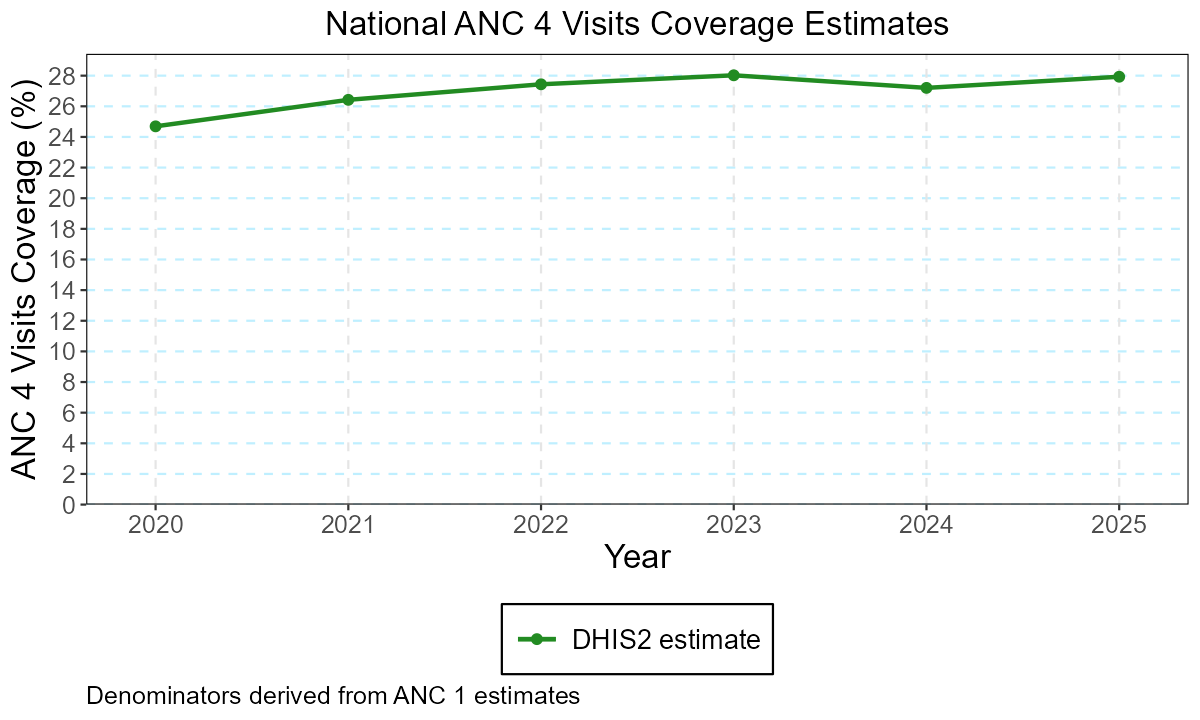
Reading the chart: each point is a year's ANC4 coverage from the adjusted facility data (the DHIS2 estimate), with the denominator named in the caption: here the pregnant women derived from ANC1. In a country dataset, the survey estimates (with their 95% confidence interval) are drawn on the same chart; the example dataset has no survey file, so only the facility line is shown.
What it shows: ANC4 coverage rose from 24.7% in the first year to 28.0% in the fourth and stayed near 28% after (27.9% in the last year). In the same dataset ANC1 coverage is 78% (see the continuum of care example): most women make a first visit but only about a third of them make four. ANC4 is far from the 70% and 90% targets. The survey value for ANC4 is twice as high (see the comparison with the survey), so incomplete recording of fourth visits should be checked before concluding that coverage is this low.
Next steps
ANC4 and first-trimester ANC are modelled in the Bayesian modeling approach, which combines them with the survey estimates. Their distribution between areas and districts, and the share of areas that reach the ANC4 target, are in the Subnational analysis.