
Private sector and RMNCAH-N services
The share of health facilities that are private, NGO or public, and the share of RMNCAH-N services provided by the private sector.
Health facilities belong to the government (public), to private owners, or to non-governmental organizations (NGO). This part shows the ownership of the facilities by region, from the facility data, and the share of some RMNCAH-NRMNCAH Reproductive, maternal, newborn, child and adolescent health: the services the RMNCAH analysis covers, from antenatal care to child immunization. services that people receive from the private sector, from household surveysHousehold survey A national survey, such as a DHS or MICS, that measures coverage by interviewing a sample of households. Its coverage figures are used as a benchmark for the facility data..
At a glance
- Measures: the percent of facilities that are private, NGO and public, by region; the private share of care-seeking for child illness, caesarean sections and institutional deliveries, nationally and by area of residence.
- Good result: not a target: a description that helps read the other results.
- In the app: the ownership card and the National and Urban/Rural tabs of Public/Private Share.
Why
Private facilities are counted in the facility density of the inputs, but they may report fewer of their services to the health information system than public facilities. Where the private sector is large, services can look low in the facility data while people are receiving them, and the comparison of outputs by inputs has to take it into account.
What
| Indicator | Numerator | Denominator | Interpretation |
|---|---|---|---|
| Share of private facilities | Number of private (for-profit) facilities | Number of health facilities | A large share means many services may happen outside public reporting |
| Share of NGO facilities | Number of NGO (not-for-profit) facilities | Number of health facilities | |
| Share of public facilities | 100% minus the private and NGO shares | ||
| Private share of a service (survey) | Prevalence of the service received in the private sector | Prevalence received in the public and private sectors | Shown for care-seeking for child illness, caesarean section and institutional delivery |
Formula
where
- , and are the numbers of private, NGO and all health facilities in the latest year;
- is the private share of a service;
- and are the survey prevalence of the service received in the private and in the public sector.
Worked example: in a region with 300 facilities, of which 120 private and 3 NGO, the shares are 120 ÷ 300 × 100 = 40% private, 1% NGO and 59% public.
Interpretation
- Which regions have a large private sector? Read their service rates with care: services in private facilities may be missing from the facility data.
- Does the private share of services in the survey match the share of private facilities? A large gap shows whether private facilities provide many services or few.
- Is the private share different in urban and rural areas? It usually is: private facilities tend to be concentrated in towns.
- Check that the year in the chart title matches your data before quoting it.
Example: ownership of health facilities by region
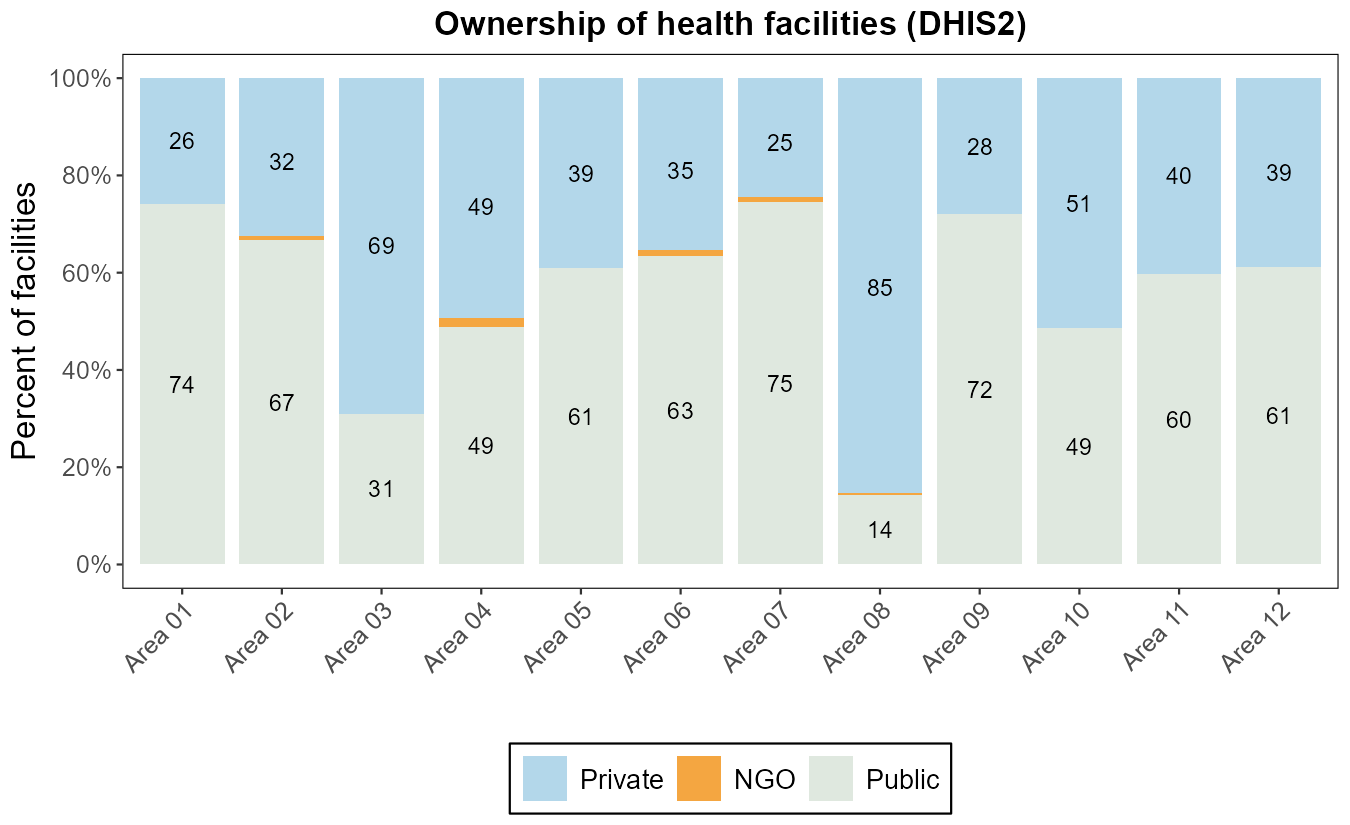
Reading the chart: one bar per Admin 1Admin 1 The first level below the national level, such as a region, province or department. Districts (Admin 2) are the level below it. region, divided into private (blue), NGO (orange, very thin) and public (grey) facilities, in percent.
What it shows: the private share ranges from 25% to 85%: in Area 08, 85% of the facilities are private, and in Area 03, 69%; in the other regions it is between 25% and 51%. NGO facilities are at most 2%. Area 08 is also the region with the highest facility density, and its service index is below the median (see Health systems outputs by inputs): part of the services of its many private facilities may not be in the facility data.
The survey-based charts (private share of services, national and urban or rural) are not shown: they need survey data on the sector of care, which the example dataset does not include.
After the analysis
The private sector share is part of the context for the findings brought to Planning for dissemination, decisions and action.