
Public/Private Share
How much of the health system is private, and how much care do private providers give?
This page shows how much of the health system is private: the share of private and NGO facilities in each region, from your facility data, and the share of key services given by private providers, from household surveys. It is the last page of Health System Performance. Read it before you interpret service rates from facility data: where the private sector is large, some care may be missing from those data. RMNCAH
Before you start: run Data Adjustment.
Using the page
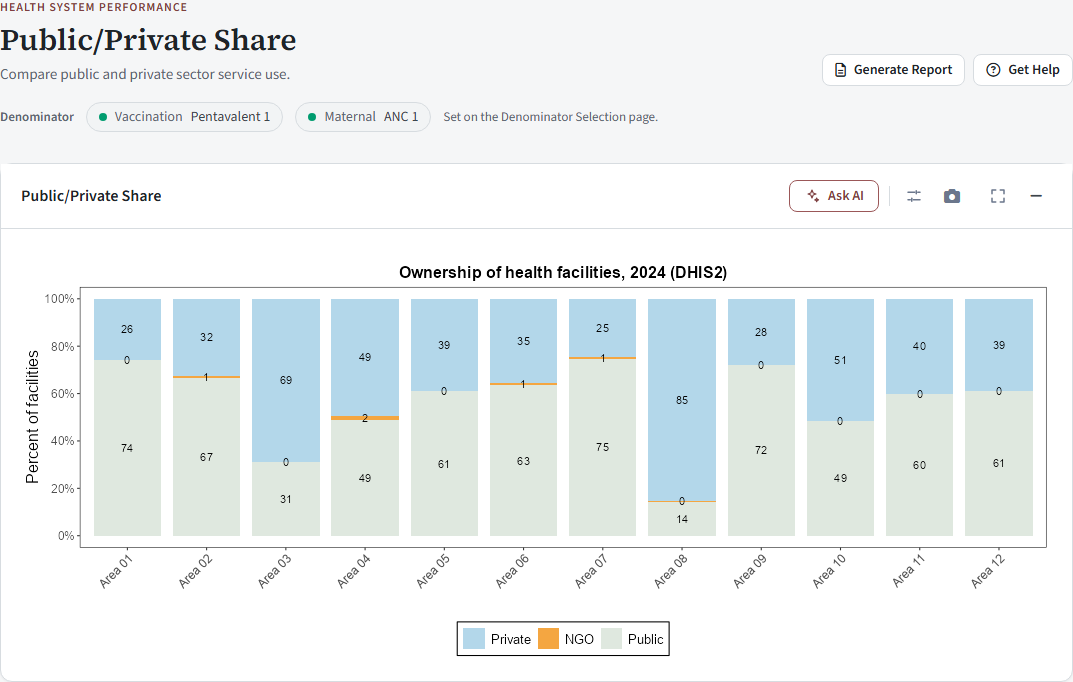
Read the ownership chart
Note the regions with a large Private or NGO share.
Read the survey chart
Open National, then Area, to see the private share of care for sick children, caesarean sections and deliveries.
Create the report
Press Generate Report for the Public/private share report, or go on to Reports.
Controls
No filters. Generate Report creates the Public/private share standard report.
Cards
Public/Private Share (ownership): for each region, the percentage of facilities that are Private, NGO and Public, from the facility data. The minus button in the card header folds the card.
How to read it: regions with a large private or NGO share are where facility data are most likely to miss services. A region with no private facilities at all may simply not report them.
Public/Private Share (services): tabs National and Area (urban and rural). Bars split care-seeking for child illness, caesarean sections and institutional deliveries into public and private sectors, with the private share written above. These figures come from the household survey estimates built into the app; the chart stays empty when there are none for your country.
How to read it: compare the private share of services with the share of private facilities. A large gap tells you whether private facilities give many services or few. Private shares are usually higher in urban areas.
The ownership chart title reads Ownership of health facilities, 2024 (DHIS2) whatever your data years. Check the years before you quote it.
Common pitfalls
- Quoting the year in the ownership chart title.
- Reading an empty survey chart as no private care: it means there are no survey estimates for your country in the app.
Method: Private sector and RMNCAH-N services. Next: Reports.