
Data Quality Assessment
The five Data Quality Assessment pages (Reporting Rate, Outlier Detection, Data Missingness, Internal Consistency, Overall Data Quality Score) that show whether the facility data can be trusted.
Can these numbers be trusted?
Before any coverage is calculated, five pages show how complete, plausible and consistent the facility data are, and where they are not. What you find guides the choices on Data Adjustment. RMNCAH Vaxx
Pages
How completely facilities sent their monthly reports.
Monthly values far from the usual ones.
Indicators and areas with months that have no value.
Whether related indicators agree with each other.
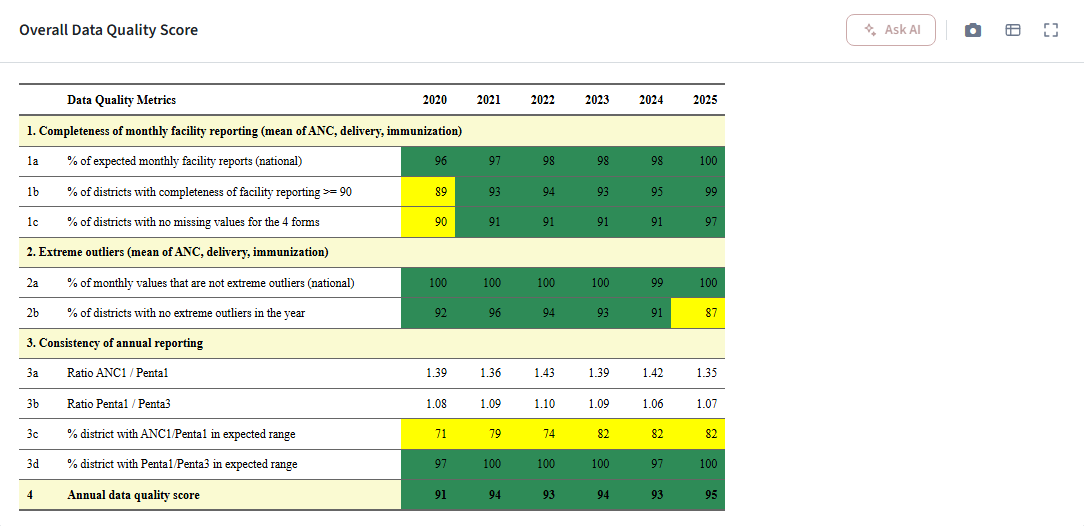
How good the data are each year, in one table.
Before you start: finish Load Data. Review the pages in the sidebar order and come back to them whenever you load a corrected file.
flowchart TD
  L["Load Data"] --> R["Reporting Rate"] --> O["Outlier Detection"] --> M["Data Missingness"] --> I["Internal Consistency"] --> S["Overall Data Quality Score"]
  S --> A["Data Adjustment"]:::done
  S -- "errors the districts can correct" --> F["Correct the file and load it again"]:::warn
  F -.-> L
Most pages have a filter bar at the top, All charts on this page: it changes every card on the page. A control marked This table only changes one table. Every card can be downloaded or explained with Ask AI (Exports and Ask AI).
Common pitfalls
- Changing the Performance Threshold to make the data look better: it is stored in the dataset and changes the score and the adjustment too. Set it once.
- Reading the charts with the wrong filter: the filter bar changes every card, and a region chosen in the Admin 1 chip stays chosen.
- Expected ratios that look wrong: check the survey values in National Rates.
- Moving on without asking the districts: errors they can correct at the source are better fixed in the file than by the adjustment.
Pitfalls in reading the results: Data quality assessment > Common pitfalls.
Next: Data Adjustment.