
Mortality Completeness
What share of deaths do facilities report, compared with the deaths expected from the UN mortality estimates?
This page estimates what share of maternal deaths and stillbirths the facilities report, by comparing the reported rates with the UN mortality estimatesUN mortality estimates The UN inter-agency estimates of maternal mortality, stillbirth and neonatal mortality for each country, with a lower bound, best estimate and upper bound (for stillbirths, 90% uncertainty intervals). The RMNCAH app has them built in, or you upload your own.. It is the last page of the Mortality group, after Institutional Mortality and Mortality Mapping. You leave it knowing how far the facility rates can be trusted, and you can create the Mortality report from here. RMNCAH
Before you start: choose the denominators on Denominator Selection; the page stays empty until they are set.
Using the page
Open a tab
Institutional MMR for maternal deaths, Institutional SBR for stillbirths.
Pick the scenarios that fit
Choose the line that matches what you know of the true mortality (lower bound, best estimate or upper bound) and the ratios of community to facility mortality that are realistic for your country. Read the completeness at those points only.
Create the report
Press Generate Report to create the Mortality report, or Download Data to keep the figures.
Controls
This page has no filters. Generate Report, next to Get Help, creates the Mortality standard report and opens it on the Reports page.
Cards
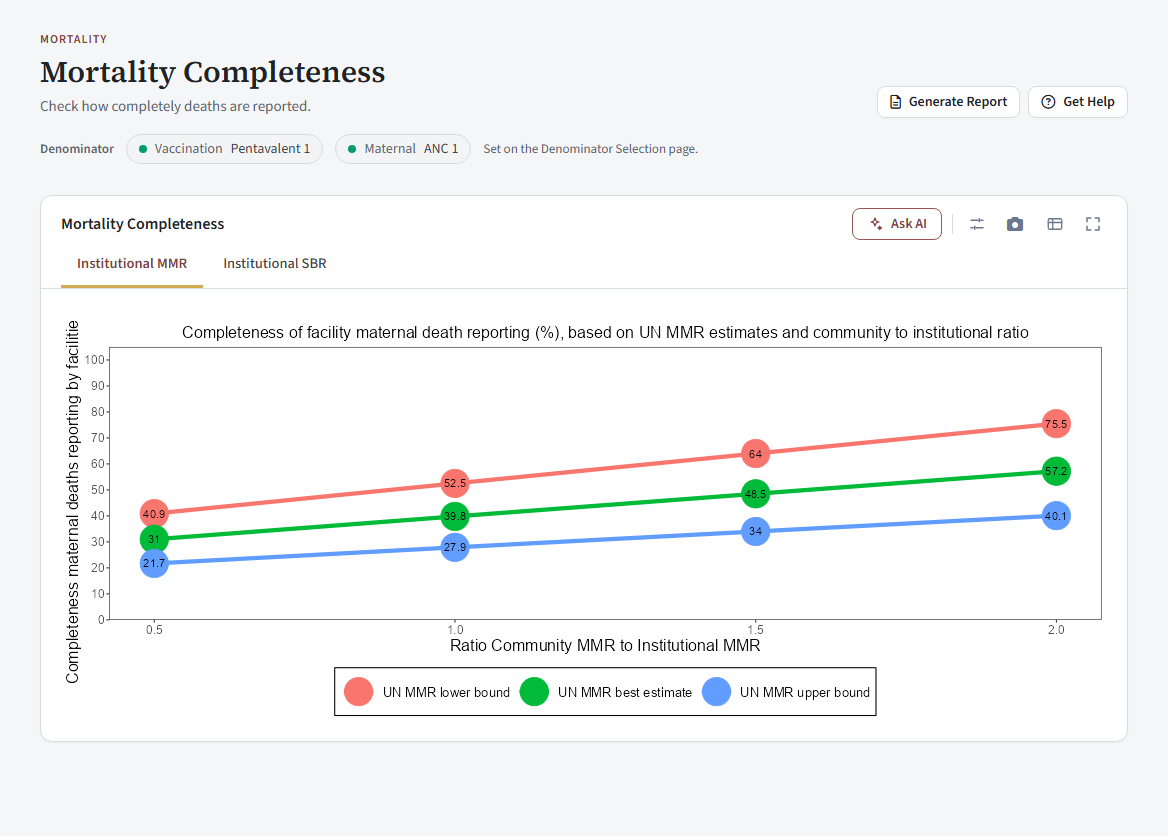
Mortality Completeness: the completeness of facility death reporting, in percent. The horizontal axis is the assumed ratio of community to institutional mortalityCommunity-to-institutional ratio The assumed ratio of community to institutional mortality (M_c / M_i), used to compute the expected institutional rate; the apps compare 0.5, 1, 1.5 and 2., from 0.5 to 2. There is one line for each UN estimate: lower bound, best estimate and upper bound. Each circle gives the completeness for that scenario. Tabs Institutional MMR (maternal deaths) and Institutional SBR (stillbirths).
How to read it: completeness close to 100% in the scenarios that fit your country means facilities report most deaths. Low values in every plausible scenario mean the facility rates are too low and death reporting needs strengthening. A value above 100% means that scenario does not fit: facilities cannot report more deaths than occur.
The page uses the UN estimates built into the app, or the file you loaded with Upload UN Mortality estimates in the Upload Data step of Load Data. It also uses the denominators chosen on Denominator Selection.
Common pitfalls
- Quoting the whole range of circles. Narrow it to the scenarios that fit your country first.
- Changing the denominators afterwards: the completeness changes with them, and so does the report.
- Using the built-in UN estimates when the country has newer ones: load them in the Upload Data step.
Method: Completeness of facility death reporting (how it is computed) and its interpretation (choosing the scenario). Next: Service utilization and health system.