
Institutional maternal mortality ratio (iMMR)
The number of maternal deaths in health facilities per 100,000 live births in health facilities, by region and year.
The institutional maternal mortality ratio is the number of maternal deathsMaternal death The death of a woman from any cause related to or aggravated by pregnancy or its management (excluding accidental or incidental causes) during pregnancy and childbirth or within 42 days of termination of pregnancy, irrespective of the duration and site of the pregnancy. that health facilities report for every 100,000 live birthsLive birth A baby born showing any sign of life, however briefly. Live births are the denominator of the maternal mortality ratio and of neonatal mortality; births are live births plus stillbirths. in those facilities. It is one of the three rates of institutional mortalityInstitutional mortality (iMMR, iSBR, neonatal deaths before discharge) IMMR: maternal deaths in facilities per 100,000 facility live births; iSBR: stillbirths per 1,000 facility births; neonatal deaths before discharge per 1,000 facility live births., and it is computed for each regionAdmin 1 The first level below the national level, such as a region, province or department. Districts (Admin 2) are the level below it. and for the whole country, year by year.
At a glance
- Measures: maternal deaths in health facilities per 100,000 facility live births.
- Good result: a level consistent with the population maternal mortality, with no region implausibly low (under 25) and no extreme high values.
- In the app: the Maternal Mortality tab of the first card of Institutional Mortality, and the Maternal Mortality map of Mortality Mapping.
Why
Maternal mortality in health facilities is a critical indicator of the quality of care. The main challenge with mortality data from health facilities is under-reporting of deaths: maternal deaths do not only occur during birth, but also in pregnancy and post-partum, and deaths in other hospital wards are more likely to be missed. An implausibly low ratio is therefore more often a sign of missing reports than of good care.
What
A maternal death is the death of a woman from any cause related to or aggravated by pregnancy or its management (excluding accidental or incidental causes) during pregnancy and childbirth or within 42 days of termination of pregnancy, irrespective of the duration and site of the pregnancy. The definitions for institutional, community and population maternal mortality are outlined in the matrix below.
| Indicator | Numerator | Denominator | Interpretation |
|---|---|---|---|
| Institutional maternal mortality ratio (iMMR) | Number of maternal deaths in health facilities | Number of live births in health facilities / 100,000 | Less than 25 per 100,000 live births is implausibly low; low rates in less-developed regions indicate under-reporting |
| Population maternal mortality (MMR) | Number of maternal deaths in the population | Number of live births in the population / 100,000 | Comes from the UN estimates or a recent national survey or census |
| Community maternal mortality ratio (cMMR) | Number of maternal deaths in the community | Number of live births in the community / 100,000 | Deaths outside health facilities; not reported, but follows from the other two |
The annual ratios are computed using the unadjusted data on reported deaths and live births in health facilities: they are not adjusted for reporting rates or outliers (why: Outliers in mortality data). The institutional ratio is read against the population maternal mortality ratioPopulation maternal mortality ratio (MMR) Maternal deaths in the whole population, in health facilities and in the community, per 100,000 live births in the population. It comes from the UN estimates or a recent national survey or census., which includes the community maternal mortality ratioCommunity maternal mortality ratio (cMMR) Maternal deaths outside health facilities per 100,000 live births outside health facilities. It is not reported, but can be back-calculated from the population and institutional ratios.; how the three fit together is on Completeness of facility death reporting.
Formula
where
- is the number of maternal deaths reported by health facilities in the year;
- is the number of live births reported by health facilities in the year.
Example: 1,000 maternal deaths among 464,020 facility live births give maternal deaths per 100,000 live births.
The population (MMR) and community (cMMR) ratios use the same formula with the deaths and live births in the population or in the community.
Settings
| Setting | Default | What it means |
|---|---|---|
| Very low institutional MMR | 25 per 100,000 live births | A region whose ratio is below this value is flagged as very low, a sign of under-reported deaths. |
Interpretation
- Are there extreme high values? Assess if there are any extreme outliers on the high side that may be due to major data entry errors. Flag them for potential correction or exclusion (see Outliers in mortality data).
- How many regions have an implausibly low ratio? It is arbitrarily defined as less than 25 per 100,000 live births (25 is roughly two times the average MMR in high-income countries of 12.5).
- Are the low regions more advanced areas, or less-developed ones? In more advanced areas lower mortality is expected. Low mortality in less-developed regions strongly indicates a major under-reporting of institutional deaths rather than superior clinical outcomes.
- How far is the iMMR from the population estimate? Compare it with the most recent population estimate, from a recent national survey or census, or the UN estimatesUN mortality estimates The UN inter-agency estimates of maternal mortality, stillbirth and neonatal mortality for each country, with a lower bound, best estimate and upper bound (for stillbirths, 90% uncertainty intervals). The RMNCAH app has them built in, or you upload your own. for maternal mortality, including their uncertainty range. This difference is used to estimate the completeness of facility death reporting.
- Where do the deaths come from? If data collection relies only on maternity ward logs or MPDSRMPDSR Maternal and Perinatal Death Surveillance and Response: the review of each maternal and perinatal death to learn why it happened and act on it. Sources that rely only on MPDSR or maternity ward logs miss deaths outside the labour ward. audits, deaths upon re-admission or outside the labour ward (intensive care, emergency, or general surgical wards, for example after post-abortal sepsis or delayed haemorrhage) are frequently omitted. A facility-wide all-cause mortality registry, where the underlying maternal causes are accurately coded, reduces this under-reporting.
- What does the map show? A map of the iMMR by region (in Mortality Mapping) helps to focus on spatial patterns and identify potential under-reporting across regions. High values on a map are not always high mortality: regions with few births can swing widely, and regions that report well can look worse than regions that under-report.
Example: institutional maternal mortality by region and year
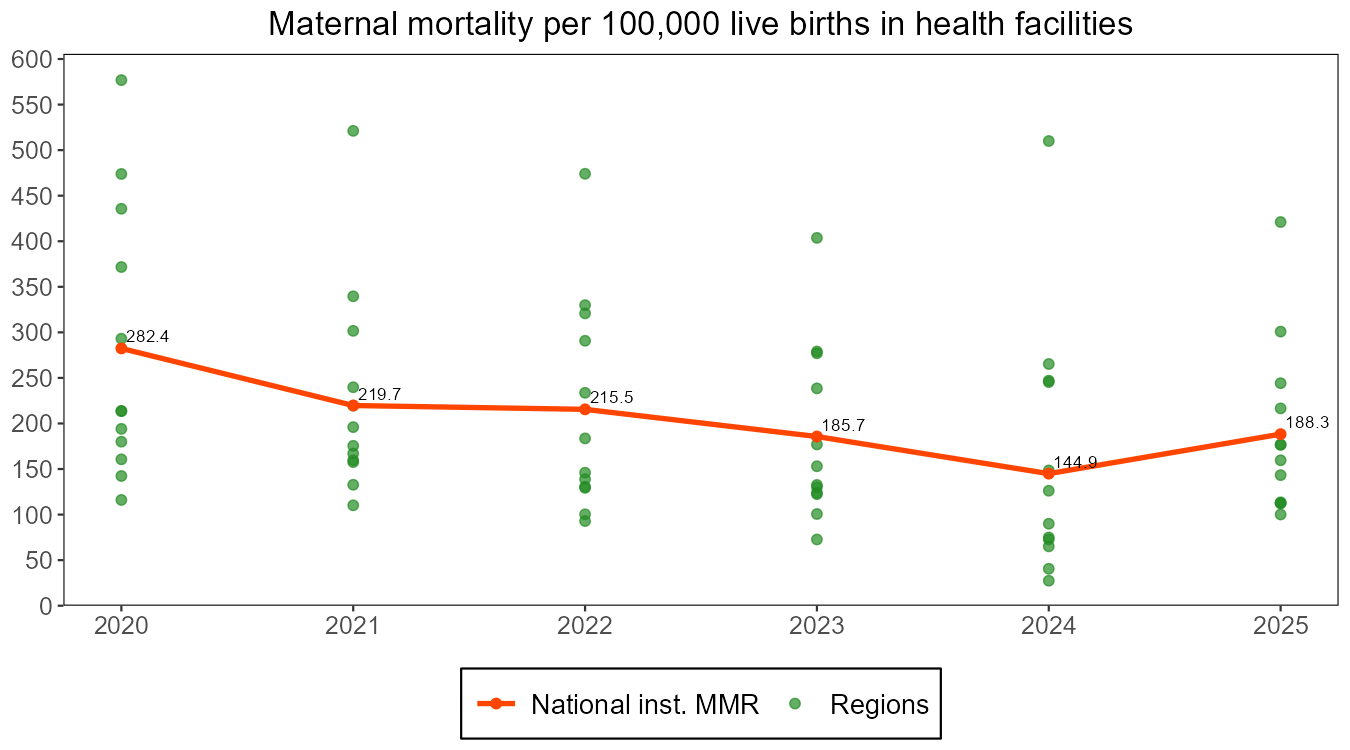
Reading the chart: each green dot is a region and the orange line the country, with its value for each year. The vertical axis is maternal deaths per 100,000 live births in health facilities.
What it shows: the national ratio fell from 282 in the first year to 145 in the fifth and rose again to 188 in the last. Regions are spread widely, from 116 to 577 in the first year. No region is below 25, but in the fifth year one region is at 27 and several are under 100. The fall in the fifth year comes from fewer reported maternal deaths (694, against 900 the year before) while facility live births stayed level; the ratio of stillbirths to maternal deaths rose the same year, which points to under-reported maternal deaths rather than better care. Check the reports of the low regions for that year.
After the assessment
The reported ratio is compared with the ratio expected from population estimates to estimate the completeness of facility death reporting. The ratios and the answers to the points to consider go into the mortality report (Reports).